

Most marketing teams sit on mountains of data but struggle to extract real value from it. AI marketing analytics changes that by automatically finding patterns, predicting customer behavior, and identifying growth opportunities humans would miss.
We at Emplibot have seen firsthand how the right analytics approach transforms raw numbers into decisions that actually move the needle. This guide walks you through the metrics that matter, how to implement AI tools without disrupting your workflow, and how to build a team that acts on insights instead of ignoring them.
How AI Spots What Humans Miss in Marketing Data
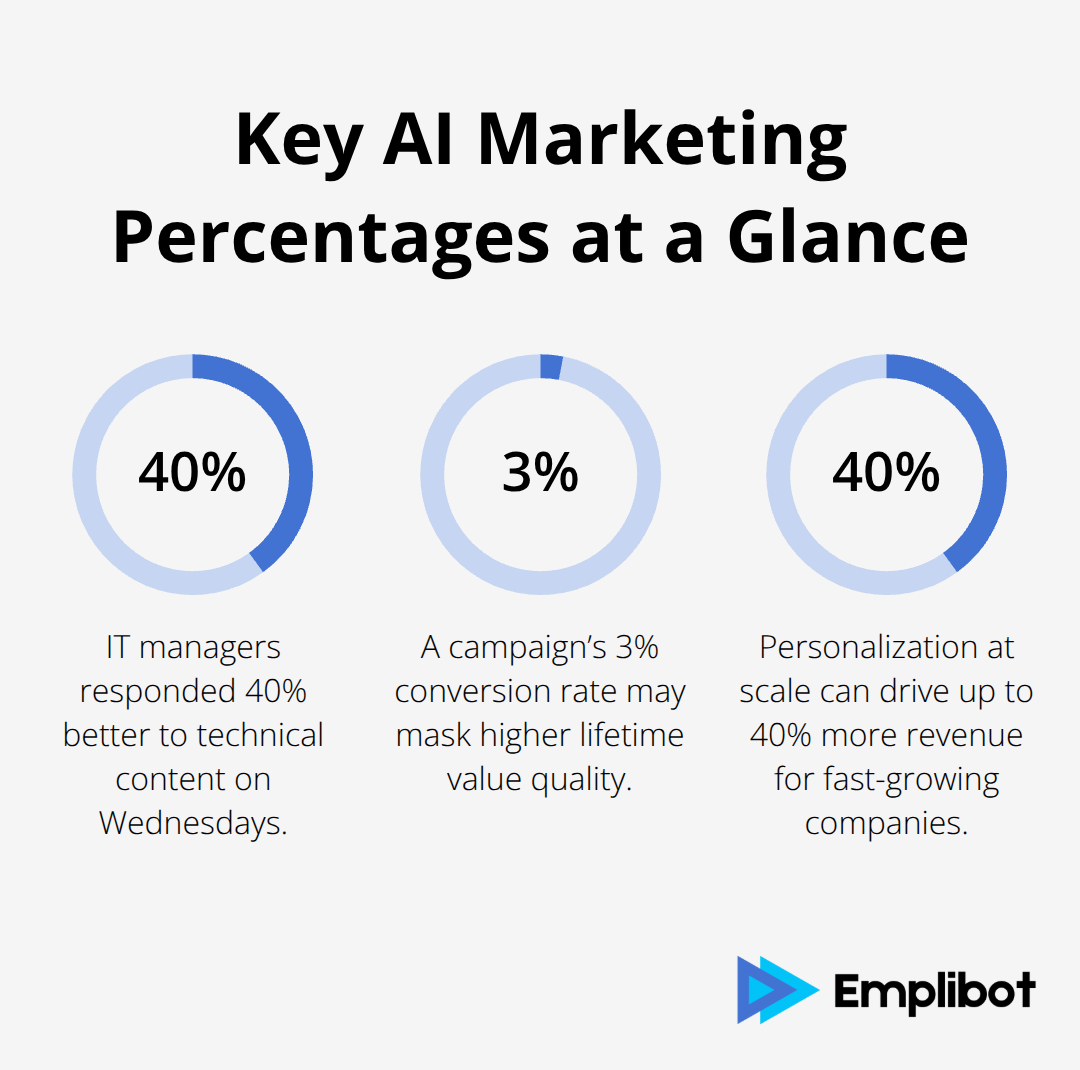
AI marketing analytics works because it processes customer interactions at a scale no human team can match. While your marketing team might notice that email open rates dipped last week, AI identifies that IT managers in the afternoon window responded 40% better to technical content on Wednesdays, while C-level executives engaged more with strategy-focused emails sent early Tuesday mornings. These timing and content patterns exist in your data right now, but finding them manually wastes weeks that your competitors don’t have. The real power isn’t just spotting patterns after they happen-it catches anomalies the moment they occur and predicts what customers will do next before they do it.
Recognizing Shifts Before They Impact Performance
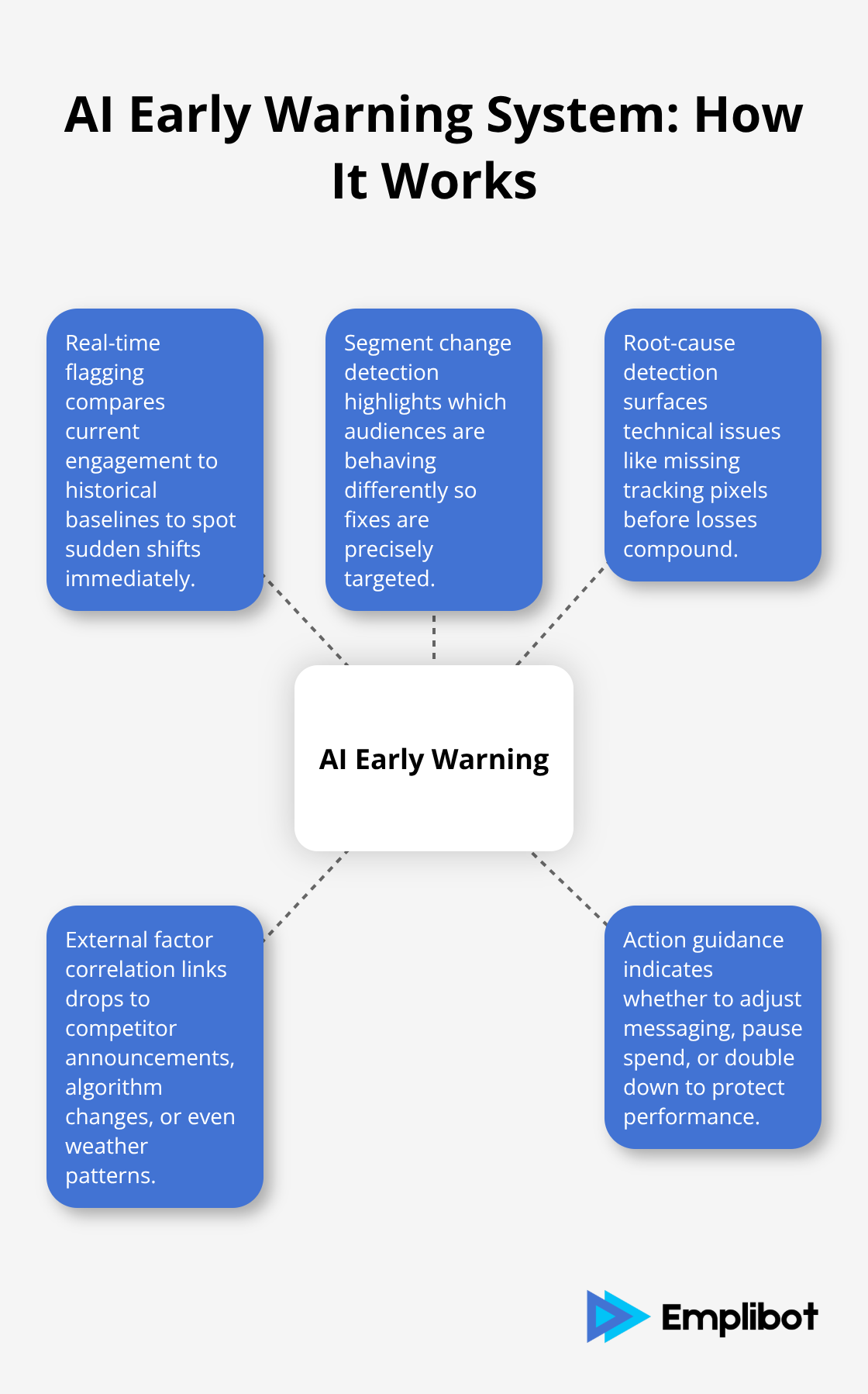
Traditional analytics show you yesterday’s numbers. AI analytics show you today’s trends and tomorrow’s risks. When a campaign suddenly underperforms, most teams notice it after 48 hours of lost revenue. AI flags the shift in real-time by comparing current engagement against historical baselines and identifying which segments are behaving differently. A decline may stem from fewer visitors, a missing tracking pixel, or other technical issues that AI detects immediately and alerts you to investigate. More importantly, it correlates that drop with external factors-a competitor’s announcement, a platform algorithm change, or even weather patterns in key markets-so you know whether to adjust messaging, pause spend, or double down. This early warning system prevents small problems from becoming campaign disasters.
Predicting Customer Actions and Automating Decisions
Predictive analytics in AI platforms forecast which customers will convert, which will churn, and what content resonates with each segment before you spend money reaching them. Rather than sending the same email sequence to everyone and hoping some convert, AI identifies that customers with three or more product page visits in the last 14 days have an 8x higher conversion likelihood than those with one visit. It then routes those high-intent prospects to your sales team while nurturing lower-intent prospects with educational content. Segmentation at this level isn’t manual-AI continuously clusters your audience based on dozens of behavioral signals, creating groups as small as 50 people or as large as 50,000, each receiving tailored experiences. Personalization at scale can generate up to 40% more revenue for fast-growing companies, and that lift comes directly from AI’s ability to match the right message to the right person at the right moment. The alternative-broad, generic campaigns-leaves that revenue on the table.
Moving From Insight to Action
These patterns and predictions only matter if your team acts on them. The next chapter covers the specific metrics and KPIs that AI platforms track to measure growth, and how to set up dashboards that surface the insights your team needs to make faster decisions.
The Metrics That Actually Drive Growth
AI analytics platforms track dozens of metrics, but most marketing teams measure the wrong ones. Vanity metrics like impressions and clicks feel good in a status report but tell you nothing about whether your business is growing. The metrics that matter connect directly to revenue: how much you spend acquiring customers, how long they stay valuable, whether campaigns convert profitably, and which channels deserve more budget. AI reveals the relationships between these numbers. A campaign might show a 3% conversion rate that looks mediocre until AI correlates it with customer lifetime value data and uncovers that those converts stay 18 months longer than customers from other channels, making that channel your most profitable one. Without AI connecting these dots, you’d kill a winner and keep a loser.
Customer Acquisition Cost and Lifetime Value Tell the Complete Story
Customer acquisition cost and lifetime value form the foundation of sustainable growth. If your CAC is $50 but customers spend an average of $300 over their lifetime, you have a 6:1 ratio that justifies aggressive spending. But if that ratio starts declining-say CAC rises to $75 while LTV drops to $250-AI flags the deterioration immediately and identifies which customer cohorts or channels drove the change. Personalized experiences driven by AI generate measurable revenue gains, and that revenue compounds when you understand which acquisition sources deliver high-value customers versus one-time buyers. Too many teams optimize for low CAC alone, acquiring cheap customers who never return. AI prevents that mistake by measuring the full economic picture.
Attribution Modeling Reveals Your True Conversion Drivers
Conversion rate analysis becomes far more useful when AI attributes conversions accurately across touchpoints. Traditional last-click attribution credits the final email or ad for a sale, but the customer probably encountered your brand weeks earlier through search, saw a retargeting ad, read a blog post, and only then clicked the final link. AI models like multi-touch attribution distribute credit across all those interactions, revealing that your organic content drives conversions even though the last click came from paid search. This changes where you invest. If you cut blog spending to fund more ads, you’d actually lose conversions because you removed a critical early-stage touchpoint.
Real-Time ROI Measurement Across Channels
ROI measurement across channels becomes granular and real-time with AI. Instead of waiting until month-end to calculate returns, AI shows you daily ROI by channel, audience segment, and creative variation. You discover that LinkedIn performs differently for B2B tech versus manufacturing, that video ads drive higher-value conversions than static images, or that morning sends outperform afternoon sends for your specific audience. These patterns exist in your data now, but manual analysis misses them. AI surfaces them instantly, letting you shift budget toward winning combinations before competitors catch on. The next chapter walks you through implementing these metrics in your own stack and building dashboards that surface the insights your team needs to act fast.
Building Your AI Analytics Foundation Without Starting From Scratch
Connect Your Existing Tools Into a Unified Data Pipeline
Most marketing teams already own the tools needed to implement AI analytics-they just treat them as separate silos. Your email platform knows open rates and click patterns. Your CRM tracks deal stages and customer interactions. Your analytics tool records traffic sources and user behavior. Google Ads Smart Bidding already uses AI to optimize bids in real time, but that intelligence stays trapped in Google’s ecosystem unless you extract the data. The first practical step is selecting a platform that ingests data from your existing tools without forcing migration. HubSpot, Salesforce Marketing Cloud Intelligence, and GA4 all connect to multiple sources and apply AI on top of unified data. Start by auditing what data lives where, then assign one person to own the integration and give them two weeks to get it live. Most platforms offer prebuilt connectors that handle data cleaning automatically, so your team avoids weeks of normalizing formats or fixing inconsistencies. The goal isn’t perfection on day one; it’s getting data to flow so you can start seeing patterns immediately.
Build Simple Dashboards That Your Team Actually Uses
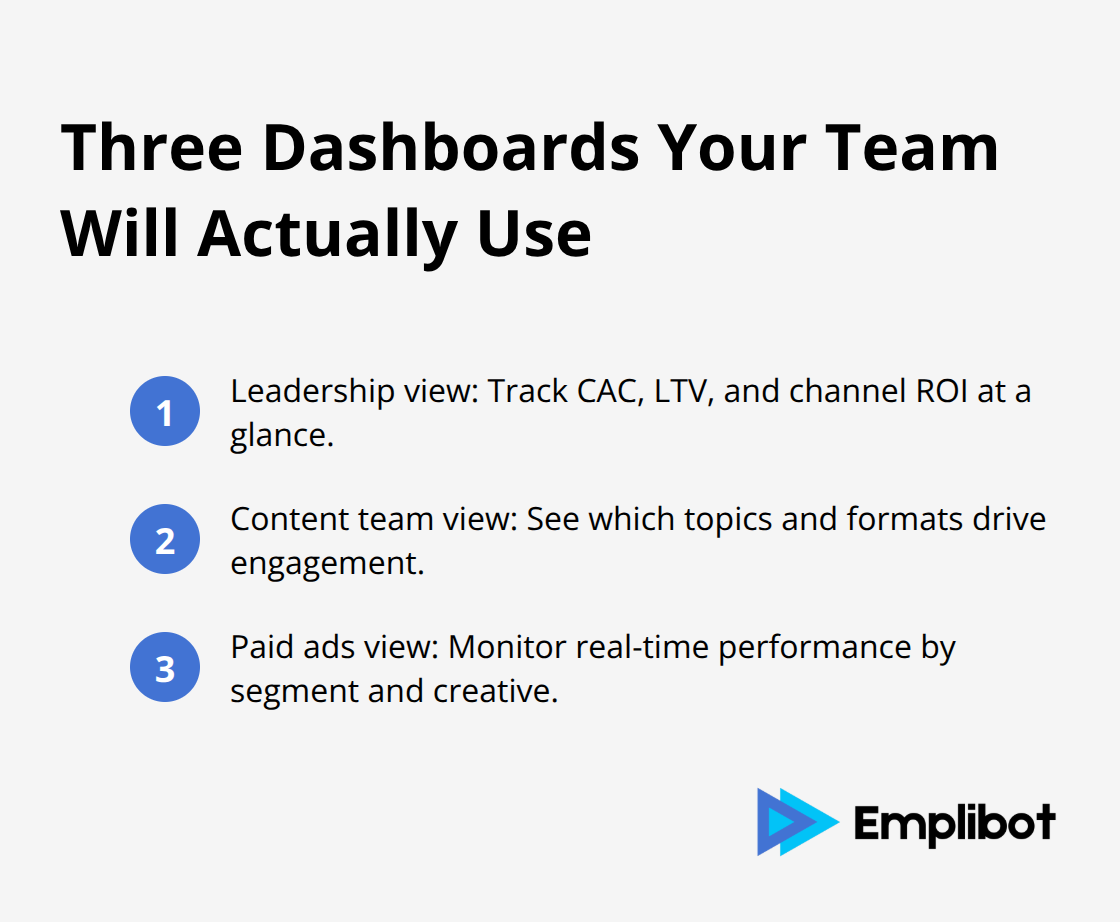
Too many teams create 50-metric dashboards that no one reads. Instead, build three separate views: one for leadership showing CAC, LTV, and channel ROI; one for your content team showing which topics and formats drive engagement; and one for your paid advertising team showing real-time performance by segment and creative. Each dashboard fits on a single screen without scrolling.
Most platforms generate natural language summaries automatically-GA4 and HubSpot both produce AI-written insights that explain what happened and why, saving your team hours of interpretation. Set automated alerts so your team gets notified when CAC rises 15% or conversion rates drop below historical averages, rather than checking dashboards manually. This approach prevents information overload while keeping critical metrics visible.
Establish Clear Decision Protocols Around AI Recommendations
The real leverage comes from training your team to act on insights within 24 hours. Establish a standing weekly meeting where you review AI-generated recommendations and decide on actions-pause underperforming campaigns, shift budget to winning channels, test new audience segments, or adjust messaging based on engagement patterns. Your team needs clear structure: AI surfaces the opportunity, humans decide the action, and systems execute it automatically. This separation prevents both over-reliance on automation and decision paralysis.
Scale Gradually Through Iterative Workflows
Start with one workflow-perhaps optimizing email send times based on segment engagement windows-and measure the impact over four weeks, then scale to the next workflow. This iterative approach prevents overwhelming your team and builds confidence in AI recommendations faster than trying to transform everything simultaneously. Document what works, what doesn’t, and why. Share wins across departments so other teams adopt successful patterns. Each successful workflow becomes a template for the next one, accelerating your overall adoption curve.
Final Thoughts
AI marketing analytics transforms how teams grow by shifting from reactive reporting to predictive intelligence. Your marketing function stops chasing yesterday’s numbers and starts steering tomorrow’s revenue. Teams that implement these systems move faster, allocate budgets smarter, and capture opportunities competitors miss. While competitors still debate whether to adopt AI marketing analytics, you’re already using real-time pattern recognition to catch market shifts before they impact performance.
Start this week by auditing your data sources and picking your first AI platform. Set a four-week deadline to get dashboards live and train your team on interpreting recommendations. Document what works, then scale gradually-this iterative approach builds team confidence and prevents the overwhelm that kills most AI initiatives before they gain traction. The infrastructure exists now; your email platform, CRM, and analytics tool already contain the data you need (modern AI platforms connect these silos automatically and surface recommendations your team can act on immediately).
Emplibot automates your WordPress blog and social media by handling keyword research, content creation, and SEO optimization-freeing your team to focus on strategy and acting on the insights AI marketing analytics uncovers. The combination of automated content production and intelligent analytics creates a growth engine that runs continuously. Your competitive advantage compounds over time as that gap widens every quarter.