
Your WordPress content promotion efforts are probably reaching only a fraction of your potential audience. Most WordPress sites publish great content but fail to get it in front of the right people because promotion happens manually, inconsistently, and across too few channels.
At Emplibot, we’ve seen firsthand how automation transforms this problem. The sites that grow fastest aren’t necessarily those with better content-they’re the ones with smarter distribution systems that work around the clock.
Why Your WordPress Content Disappears
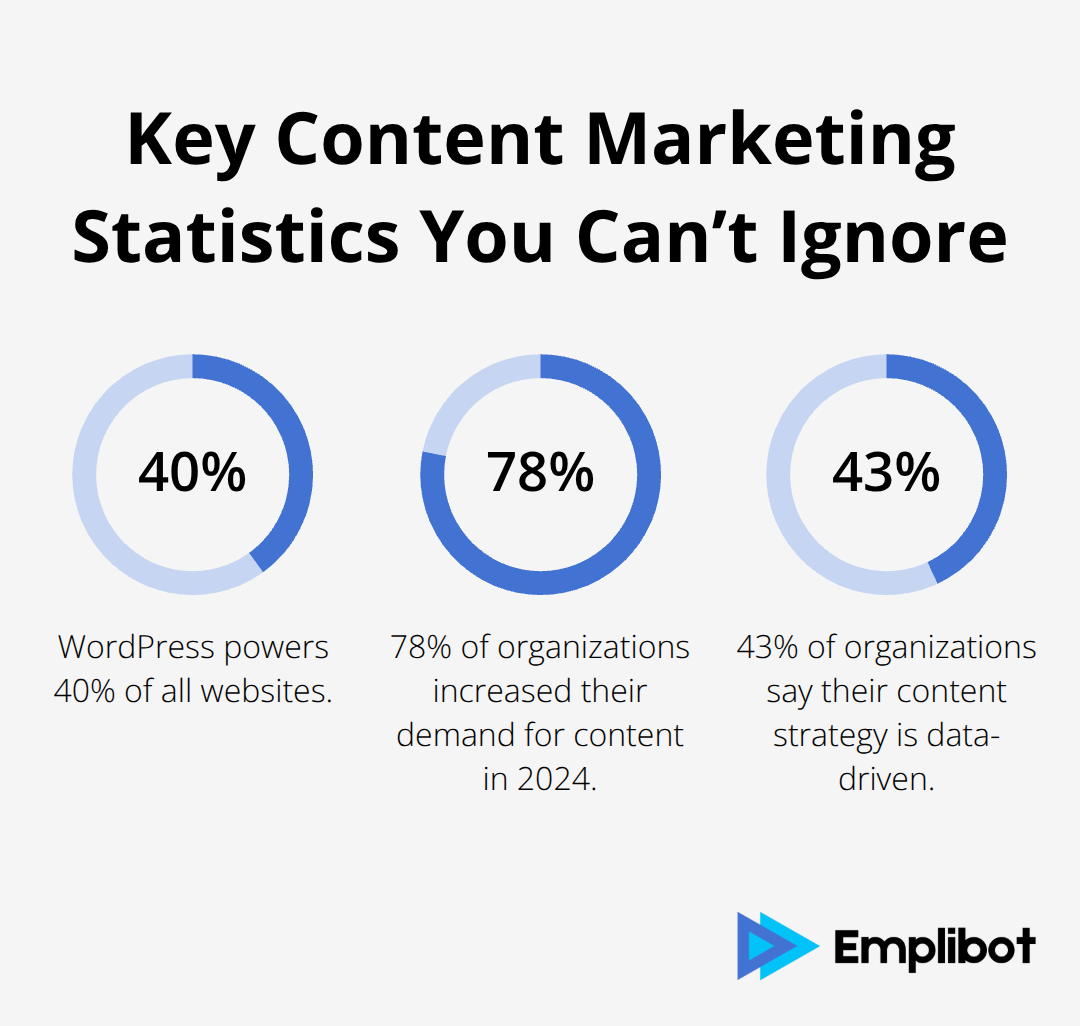
WordPress powers over 40% of all websites, yet most WordPress site owners watch their carefully crafted posts generate minimal traffic. The problem isn’t the content quality-it’s that publishing to WordPress alone guarantees almost nothing. Social media algorithms have fundamentally changed how content spreads, and manual promotion has become inefficient at scale.
Research from content marketing leaders shows that 78% of organizations increased their demand for content in 2024, but most haven’t increased their budgets to match. This creates a brutal reality: teams must produce more content with the same resources, which means promotion gets squeezed out entirely. When you’re already stretched thin creating posts, the idea of manually sharing each piece across LinkedIn, Facebook, Twitter, and other platforms feels impossible.
Most WordPress sites publish once and hope organic search picks it up eventually. Meanwhile, your competitors who coordinate their distribution across multiple channels see 50-60% of their traffic flow from social media, according to current content distribution benchmarks. That’s traffic you’re leaving on the table.
The Algorithm Problem Is Worse Than You Think
Social media ranking algorithms primarily personalize content to individual users by predicting what they will engage with. LinkedIn’s algorithm prioritizes posts that generate comments and shares within the first hour of publishing. Facebook deprioritizes links to external websites unless they generate immediate interaction. Twitter’s feed now surfaces posts based on engagement rather than recency. None of these systems care whether your WordPress post answers a complex question or solves a real business problem. They only care about clicks, comments, and shares.
Publishing your WordPress article once and sharing it once on social media means you’re competing against accounts that post multiple times daily and optimize timing for their specific audience. A single post deserves multiple distribution attempts across different platforms, at different times, with different messaging tailored to each audience. Most WordPress site owners do none of this.
Manual Promotion Doesn’t Scale
Promoting WordPress content manually takes 2-4 hours per post when you factor in crafting platform-specific copy, scheduling across channels, monitoring responses, and adjusting based on early performance. A site publishing twice weekly faces 8-16 hours of promotion work monthly before considering any optimization or strategy refinement. This explains why consistency falls apart. Teams start strong, sharing new posts across platforms with enthusiasm. Within weeks, promotion becomes sporadic as other priorities consume time.
Research shows that 43% of organizations actually treat their content strategy as data-driven. The gap between intention and execution exists largely because manual workflows can’t sustain both content creation and intelligent promotion simultaneously. The sites that maintain consistent reach across social platforms aren’t more talented-they’ve simply automated the distribution process so promotion happens without daily human intervention.
What Happens When You Stop Promoting Manually
Your WordPress posts deserve better than a single share on one platform. The moment you stop treating promotion as a daily task and start treating it as a system, your reach transforms. Automation doesn’t replace strategy-it executes strategy consistently, at scale, without the human fatigue that kills most promotion efforts. The question isn’t whether you have time to automate your promotion. The question is whether you can afford not to.
How to Reach the Right Audience on Each Platform
Tailor Your Message to Platform Norms
Most WordPress site owners treat social media as a single distribution channel, which wastes reach because each platform attracts different audiences with different expectations. LinkedIn’s professional users want detailed insights and industry analysis. Facebook users scroll quickly and respond to visual storytelling. Twitter rewards timely commentary and conversation.
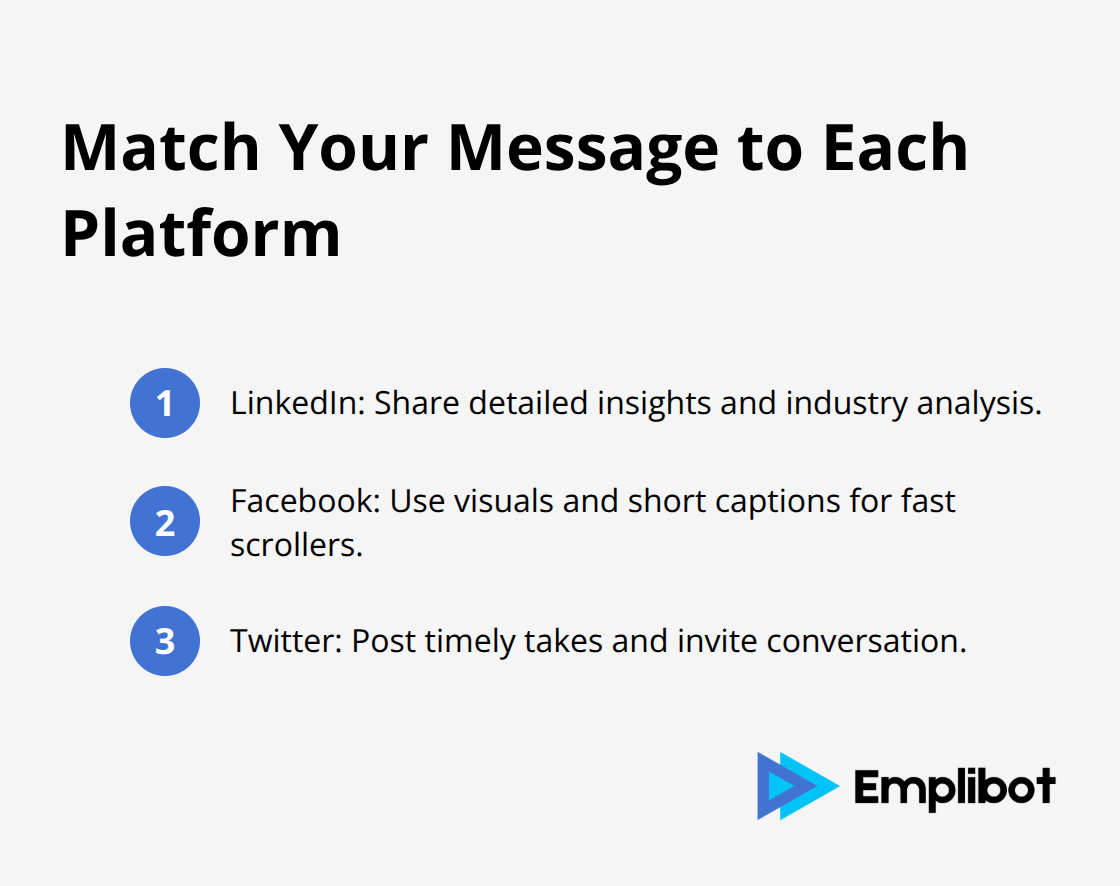
Publishing identical content across these platforms ignores what each audience actually wants. Research shows that teams that align content to channel strengths see higher engagement and stronger brand authority, but that traffic only materializes when you match your message to platform norms and user expectations.
Your WordPress article becomes source material that transforms into multiple platform-specific posts. A WordPress piece about WordPress performance optimization might become a technical breakdown on LinkedIn, a quick tip with a screenshot on Twitter, and a visual infographic on Facebook. The same underlying content shifts into three completely different posts optimized for three different audiences. This requires strategy, but it doesn’t require creating new content from scratch.
Publish at Times When Your Audience Listens
Timing matters more than most WordPress marketers realize. LinkedIn’s algorithm heavily rewards posts that generate comments and shares within the first hour, which means publishing at 8 AM Tuesday when your audience checks work email outperforms publishing at 6 PM when they’re offline. Facebook engagement peaks differently depending on your specific audience demographics and time zones. Staggered distribution across a 24–48 hour window reaches more people because different audience segments check different platforms at different times.
Sites that dominate their niches don’t publish once and hope for reach. They publish strategically across multiple platforms at times when their specific audiences are most active and most likely to engage. Tools that automate this scheduling eliminate guesswork and manual labor. Instead of manually posting to LinkedIn Tuesday morning, Facebook Wednesday evening, and Twitter Thursday at noon, automation handles the timing based on data about when your audience actually engages.
Consistency Transforms Your Reach
Organizations that maintain regular posting schedules across multiple platforms see dramatically higher engagement than those that post sporadically, even when the sporadic posts are individually high-quality. Consistency alone transforms reach because algorithms reward accounts that publish reliably. Your audience also learns to expect content from you at predictable times, which increases the likelihood they’ll see and engage with your posts.
The sites that dominate their niches don’t publish once and hope for reach. They publish strategically across multiple platforms at times when their specific audiences are most active and most likely to engage. This consistency eliminates the sporadic approach that kills most promotion efforts. When you establish a regular publishing rhythm across channels, your WordPress content reaches people who would otherwise miss it entirely. The next step involves building systems that maintain this consistency without consuming your team’s time.
Build Systems That Work Without You
Automation fundamentally changes what’s possible for WordPress promotion. Instead of manually posting to LinkedIn, Facebook, and Twitter every time you publish, tools handle distribution based on preset schedules and rules. This isn’t about replacing strategy-it’s about executing the strategy you’ve already decided on without requiring daily attention. Research from content marketing leaders shows that forty-six percent of B2B marketers think their content marketing budget will increase in 2025, yet teams still struggle with execution. The gap exists because teams spend so much time on manual tasks that strategic thinking becomes impossible. Automation reclaims that time.
Set Up Distribution Rules That Repeat Automatically
When you set up distribution rules once, those rules work continuously across every post you publish. A WordPress article published Tuesday morning automatically distributes to LinkedIn at 8 AM, Facebook at 6 PM, and Twitter at noon the following day-all without human intervention. You define the schedule once and it repeats for every future post.
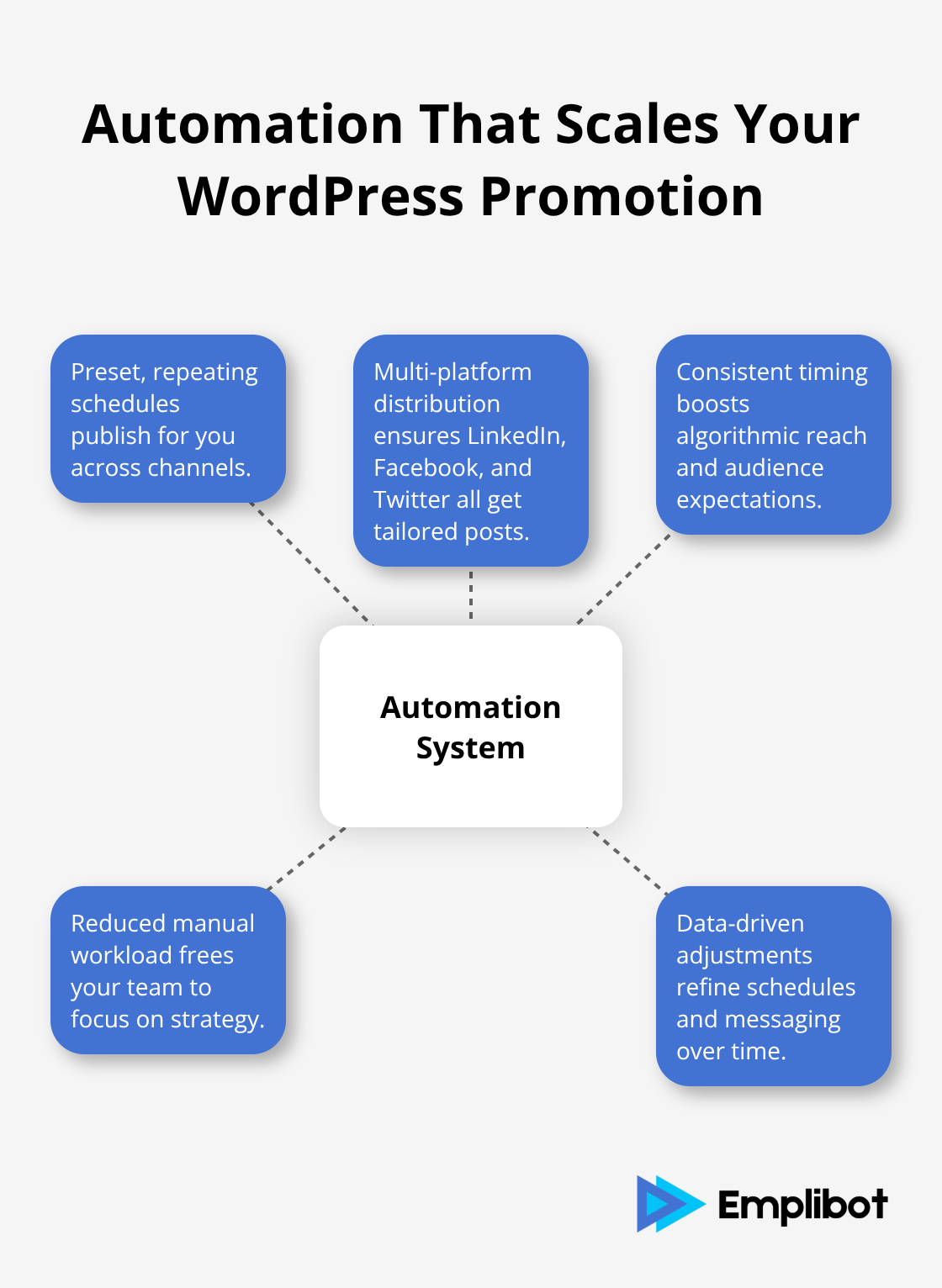
This consistency alone transforms reach because algorithms reward accounts that maintain regular publishing rhythms. Your audience learns to expect content from you at predictable times, which increases engagement rates.
The difference between sites that scale and sites that plateau comes down to systems, not talent. Teams publishing twice weekly without automation spend 8-16 hours monthly on distribution alone. With automation, that time drops to near zero after initial setup. The real competitive advantage belongs to organizations that treat promotion as a system rather than a daily task.
Adapt Your Message for Each Platform Automatically
Automation enables personalization at scale. Rather than posting identical content across platforms, you can set rules that automatically adapt messaging for each channel. A WordPress article becomes source material that transforms into LinkedIn-optimized posts highlighting professional insights, Twitter threads capturing key takeaways, and Facebook posts emphasizing visual storytelling. This isn’t manual work-it’s rules you configure once that apply to every future post.
Organizations that implement cross-channel automation see consistency improvements that manual workflows simply cannot match. The pressure to produce more content with fewer resources makes automation non-negotiable. Your WordPress content reaches exponentially more people when distribution happens reliably across multiple platforms without requiring human effort on every post.
Free Your Team to Focus on Strategy
This frees your team to focus on strategy, audience research, and content quality instead of repetitive distribution work. When distribution happens automatically, your team can invest time in understanding what your audience actually wants and creating content that resonates. The sites that dominate their niches don’t spend hours on manual posting-they invest in systems that handle distribution while they concentrate on the bigger picture.
Final Thoughts
WordPress content promotion transforms when you stop treating distribution as a daily task and start treating it as a system. The sites that dominate their niches don’t spend hours on manual posting-they invest in automation that handles distribution across multiple platforms without requiring daily attention. Your team reclaims time wasted on repetitive work and redirects it toward strategy, audience research, and content quality that actually resonates with your audience.
Manual promotion was never sustainable for teams stretched thin creating posts. Organizations that implement automation maintain consistent publishing rhythms across LinkedIn, Facebook, and Twitter while their algorithms reward the reliability. This consistency compounds month after month, and your reach grows exponentially as your audience learns to expect content at predictable times.
We at Emplibot handle everything from keyword research to content creation and distribution across platforms, which means your WordPress content reaches the right people at the right times without consuming your team’s energy. Start with Emplibot and watch what happens when promotion becomes a system instead of a daily struggle.