

Most WordPress bloggers spend 15–20 hours per week on content tasks that could be automated. Writing, editing, scheduling, and publishing drain your time while your competitors move faster.
At Emplibot, we’ve seen firsthand how WordPress blogging automation transforms this equation. The right tools cut your workload in half while your traffic and leads actually increase.
What’s Really Eating Up Your WordPress Time
Creating a single blog post demands far more than sitting down to write. Most WordPress bloggers spend 4–6 hours per post when you add up research, drafting, editing, formatting, optimizing for SEO, finding or creating images, scheduling, and promoting across social platforms. That’s 20–30 hours weekly for a modest publishing schedule of five posts. What makes this worse is that these hours happen in fragmented chunks, breaking your focus and making deep work nearly impossible. You research keywords for 30 minutes, switch to writing for an hour, then jump to image selection, then back to editing. Context-switching reduces productivity according to research from the American Psychological Association. The financial cost is real too. If you pay a freelancer $50–100 per hour, a single post costs $200–600 in labor. A five-post weekly schedule runs $1,000–3,000 weekly, or $52,000–156,000 annually. Even if you handle this yourself, that time has an opportunity cost-hours spent formatting are hours not spent on strategy, client work, or growing your business.
The SEO Optimization Trap Slows Everything Down
SEO optimization adds another layer of complexity that most bloggers handle poorly or skip entirely. You need keyword research tools, readability analysis, meta descriptions, internal linking, alt text for images, and schema markup. Tools like Yoast SEO or AIOSEO help, but they still require manual work at every step. You check keyword density, rewrite titles, adjust content structure, and build internal links one by one. This is repetitive work that doesn’t require creativity-it just requires time and attention to detail. Meanwhile, studies from HubSpot show that blogs publishing frequently get significantly more traffic than those publishing less often. But most WordPress bloggers can’t hit that cadence manually because the overhead is too high. The result is a vicious cycle: you publish less frequently, traffic stagnates, and you question whether blogging is worth the effort at all.
Where Automation Breaks the Cycle
When you automate keyword research, SEO optimization, and internal linking, you reclaim dozens of hours monthly that could go toward strategy or other high-impact work. Automation handles the repetitive tasks that drain your schedule without adding strategic value. Your team focuses on what matters-understanding your audience, refining your message, and building your brand-while the system manages the mechanical work behind the scenes.
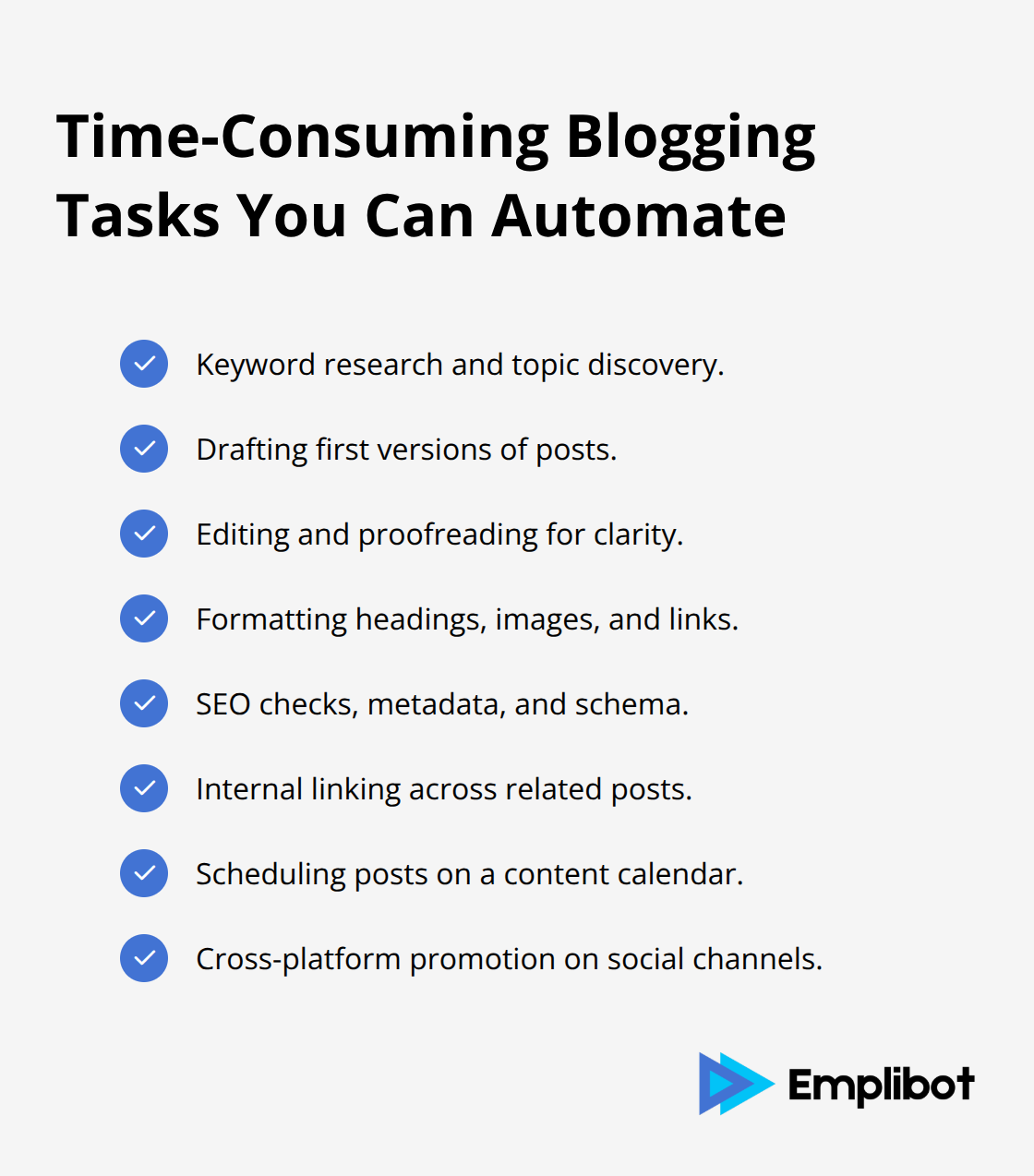
This shift transforms how you approach content. Instead of asking “Can we publish this week?” you ask “What topics matter most to our audience?” The bottleneck moves from execution to strategy, which is exactly where it should be.
How WordPress Automation Transforms Your Content Pipeline
Keyword Research Identifies High-Traffic Opportunities
WordPress automation platforms scan your industry and surface topics your audience actually searches for without manual intervention. Instead of spending hours in Google Keyword Planner or Ahrefs, automation identifies gaps where your competitors rank but you don’t, analyzes search intent and competition levels, and flags traffic potential in minutes rather than days. This speed matters because you can respond to emerging topics while they’re still trending, rather than months after your competitors have already captured the traffic.
AI drafting and SEO optimization Happen Together
Once topics are identified, the system feeds this data into content creation. AI platforms like OpenAI and Claude draft full posts based on your brand voice and target keywords, then automation runs the draft through SEO checkers that optimize title tags, meta descriptions, keyword density, and internal linking opportunities. Tools like Yoast SEO or AIOSEO integrate directly into this workflow to flag readability issues, suggest heading structure, and recommend related posts for internal linking before you ever see the draft. The result is a fully optimized post ready for human review rather than a rough draft requiring multiple rounds of editing and formatting.
Publishing and distribution Happen Simultaneously Across Channels
Once you approve a post in WordPress, automation pushes it to LinkedIn, Facebook, Twitter, and email simultaneously with platform-specific captions tailored to each audience. Tools like Buffer, Hootsuite, and Sprout Social handle scheduling and management across these channels. Your content doesn’t sit idle after publishing-automation flags posts that haven’t received traffic in 90 days, alerts you to refresh stale content, and can auto-update metadata or add new internal links to older posts without manual intervention.
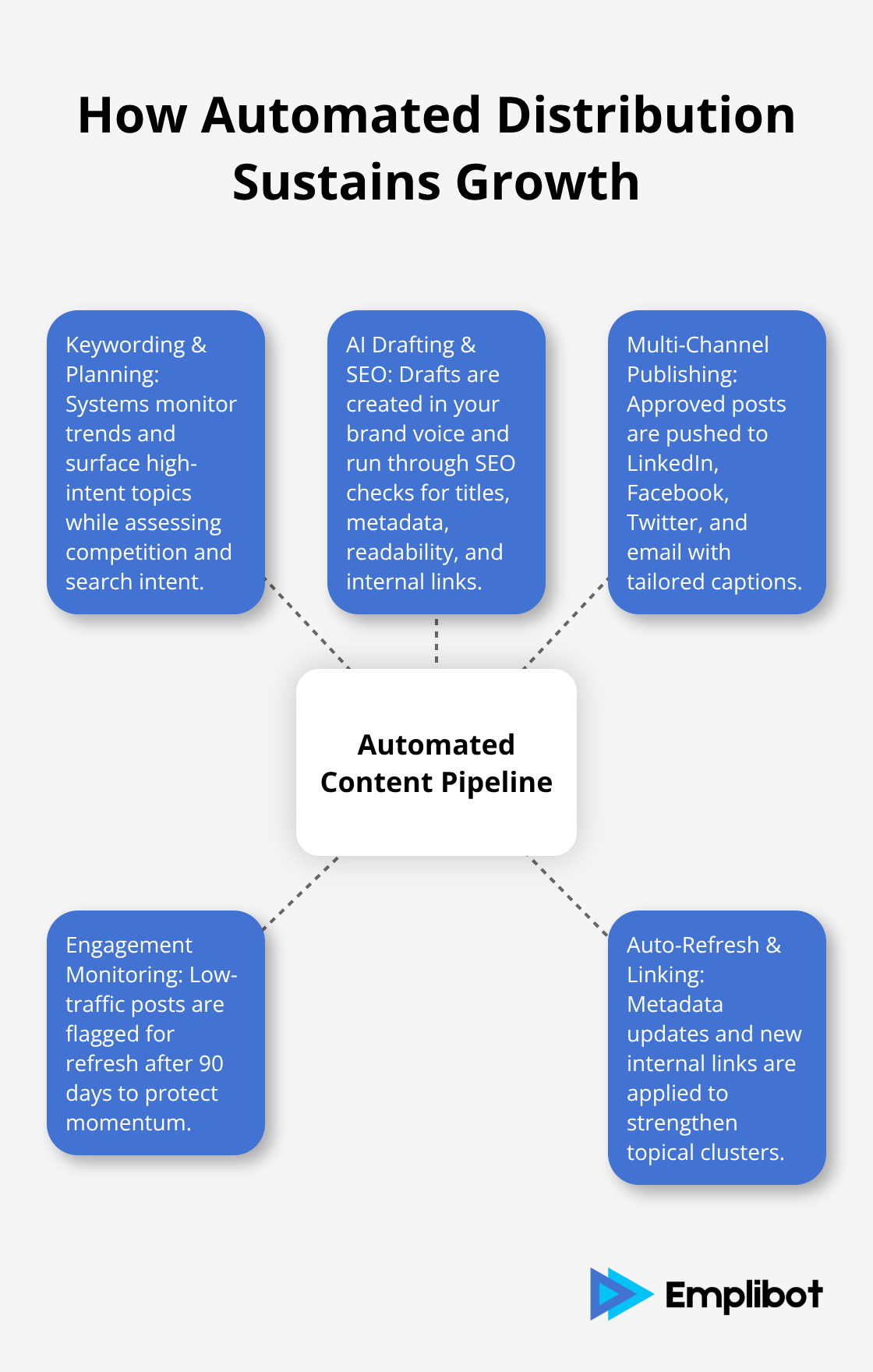
This continuous optimization cycle means your archive compounds traffic over time instead of decaying.
The Strategic Shift Happens When Execution Becomes Automatic
The practical outcome is straightforward: you publish more consistently, rank for more keywords, and drive significantly more traffic with fewer hours invested per post. Your team shifts focus from mechanical tasks (formatting, linking, scheduling) to what actually moves the needle-understanding your audience, refining your message, and building your brand. AI will revolutionize marketing by enabling hyper-personalization at scale, which means your strategic work becomes increasingly valuable as automation handles routine execution. The bottleneck moves from execution to strategy, which is exactly where it should be. This transformation sets the stage for what happens next: measuring whether all this automation actually translates into real business results.
What Automation Actually Delivers to Your Bottom Line
Traffic Gains Compound Quickly With Consistent Publishing
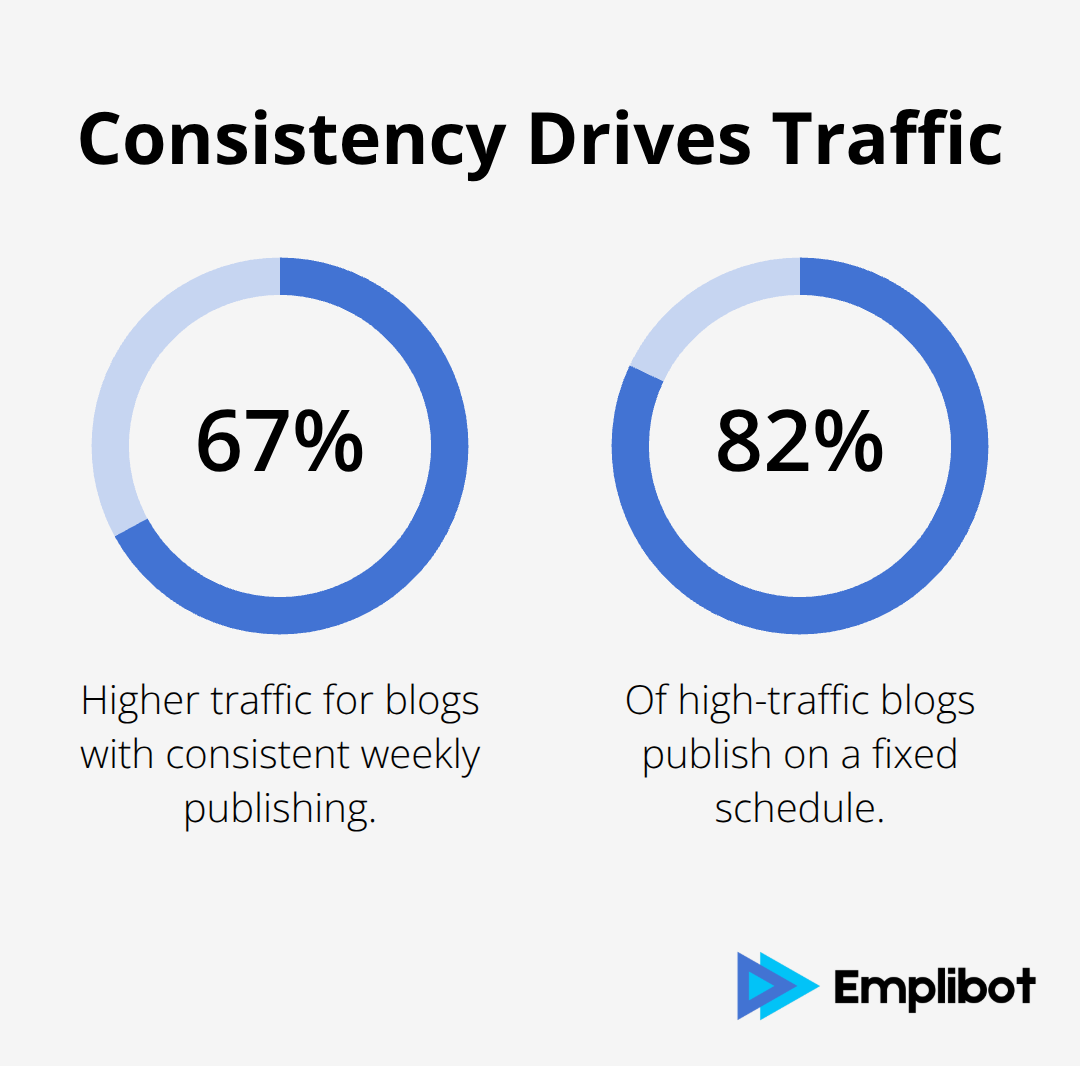
Automation transforms your content’s performance in measurable ways. WordPress sites that implement automation see traffic increases when they maintain consistent publishing schedules. 67% higher traffic comes to blogs with consistent weekly publishing compared to sporadic schedules, and 82% of high-traffic blogs publish on a fixed schedule. Frequency matters because it compounds. Blogs publishing 16+ posts monthly generate 3.5 times more traffic than those publishing just 0–4 posts monthly. Automation makes that cadence achievable without hiring additional writers.
A typical scenario illustrates the shift: a B2B SaaS company automated their WordPress blog with AI drafting and SEO optimization, moving from 2 posts monthly to 12 posts monthly within two months. Organic traffic grew significantly in that period. The cost per post dropped from $400 in freelancer fees to roughly $30 in automation platform costs-a $4,410 monthly savings while traffic climbed.
Lead volume increased proportionally because more content created more entry points for search traffic. The real win wasn’t just the time saved; it was the consistency. Manual workflows create publishing gaps during busy seasons. Automation maintains your cadence regardless of workload spikes, so your SEO momentum never stalls.
Your Team Stays Engaged When Repetitive Work Disappears
The burnout factor matters more than most businesses admit. Content teams pushing to publish manually while managing other responsibilities experience high turnover. Automation removes the repetitive mechanical work that causes fatigue while preserving the strategic, creative decisions that keep people engaged in their roles. Your team approves AI drafts, refines messaging, and decides what topics matter most-work that feels meaningful. They don’t spend afternoons formatting, fixing SEO issues, or scheduling social posts across five platforms.
One marketing director reported that after implementing automation, her team went from dreading content days to actually enjoying strategy sessions because they had mental space to think. The financial picture reinforces this: replacing a burned-out content manager costs $50,000–80,000 in recruitment and training. Preventing that burnout through automation is cheaper and preserves institutional knowledge.
Readers Stay Longer When Content Connects Naturally
Your audience experiences the difference too. Consistent publishing means they encounter your content regularly, building familiarity and trust. Automated internal linking means related posts appear where they’re contextually relevant, keeping readers on your site longer. Sites using automation show average session duration increases of 25–35% because readers navigate between related posts more frequently. That extended engagement time signals quality to search algorithms, lifting your rankings further.
The compounding effect is real: more traffic brings more conversions, more conversions justify larger content budgets, larger budgets allow for better tools and more strategic content, which drives even more traffic. Search algorithms reward sites that publish consistently, and automation ensures you show up regularly in your audience’s feeds and search results.
Final Thoughts
WordPress blogging automation isn’t a luxury anymore-it’s the baseline for competitive content marketing. The businesses winning right now aren’t the ones with the biggest teams; they’re the ones who’ve eliminated friction between strategy and execution. Manual workflows create delays, inconsistency, and burnout, while automation removes those obstacles entirely.
Start with distribution first-automate your posts to social platforms and email before layering in AI drafting and SEO optimization. This approach gives you immediate relief from the most time-consuming tasks while you build confidence in the system. You need WordPress as your foundation, an SEO plugin like Yoast or AIOSEO to handle optimization, and an automation platform that connects everything together. Emplibot handles keyword research, content creation, SEO optimization, and distribution across LinkedIn, Facebook, and Twitter to run your WordPress blogging automation on autopilot while you maintain full control over your brand voice and strategy.
Audit your current content workflow this week and identify where you spend the most time. Set up one automated workflow and watch what happens to your publishing consistency and traffic over the next month. The results will tell you whether WordPress blogging automation belongs in your strategy.